
Do We Make a Difference?
Wondering # 13


My friend Sal called me last summer, after I released the first essay in this series, and said, You have to tell this story! Then she forwarded the link of an article I’d once read (and then forgotten) about a female humpback whale just off the Farallon Islands in Northern California that’d gotten caught in crab pot lines and was so wildly tangled she was going to die. It was a story of her improbable rescue.
The waters off the Farallon islands are powerful big and so very cold. A humpback is enormous and strong, and potentially unpredictable when life-threatened. And a human? Well, we’re so small, aren’t we? And relatively defenseless in circumstances such as these, circumstances most of us don’t feel made for.

Last week, Monday, in my state, a local call went out, and alongside hundreds who answered it, I stood vigil outside a courthouse as Rümeysa Öztürk’s case was heard. Our Federal government was arguing against her. They’ve provided no evidence to support her arrest. The ACLU was arguing on her behalf. Rümeysa is a young woman, legally here in the U. S. on a Fullbright scholarship and enrolled in Tuft’s Child Study and Human Development program. Her focus of study is the well-being of children. Last year, she co-wrote an op ed (an opinion piece, sorry, I know you know this), (it bears repeating: an op ed) for the Tufts’ student newspaper (yet another thing that bears repeating — a student newspaper) calling on her university to stop funding the war on Gaza. This op ed was co-written with three other people and supported in-writing by 32 more. Because of this op ed, few weeks ago she was snatched off of the street as she walked to meet friends for dinner (watch the video and read her op ed and decide for yourself if they’re in scale), and today she remains in a high security Louisiana prison where she’s being underfed, denied her diabetes medication, and has had the clothing she wears to respect God torn from her multiple times by prison employees.
At 8:30am, we gathered. We were a crowd unknown to one another, mixed in gender, race, sexuality, religion, ability, economic background, and age. I was surrounded by hundreds of people: students, people relying on walkers and wheelchairs, moms following small children, clergy of many stripes, folks in the middle and later years of their lives. The crowd had been asked to show respect for the proceedings in the courtroom, so after the pre-hearing speeches, we stood in relative silence. Waiting. With no idea if what we were doing mattered.

I had a dream a couple weeks ago. I was walking along a green-banked very beautiful river and it began to gently rain. It was the first spring rain, and from the river surfaced beaver after beaver, each lifting its head and opening its mouth to drink in the rain. It was joyous. I couldn’t believe what I was seeing. I think in my dream I laughed. Then I kept walking. I reached a place where the city’s walled-in waters poured into a pool that was both disturbingly dirty and filled with sea creatures. There was no way out, it was where the rivers ended. Lots of people were there, gathered around railing at the edge, looking and yet not really paying attention. I was separated from them by a wall of glass. In the pool below, I saw a dog. It was a sweet chocolate lab, paddling hard to find its way out of a place that had no out, and no foothold. It didn’t belong there. As I watched, a harbor seal rose behind it, fat and spotted in the cute way they are, and then that seal wrapped its flippers around the dog and pulled it under. It was horrifying. That seal was supposed to be cute, harmless. I was looking around for someone to help, but no one else had seen, no one at the railings on the other side of the glass was watching, no one heard me, and helpless, I watched the dog’s nostrils take a last breath and disappear, pulled in the arms of the seal below the surface. It’s gone, I thought, it’s gone. And I can’t help it.

As we stood outside the courtroom, bearing witness, it turned out that just twenty minutes down the road another young man, Mohsen Mahdawi, was being arrested. A long-time green card holder, homeowner, and active community member, Moshen thought he was attending his final citizenship appointment. But he also understood that the U.S. is a dangerous place right now, especially for Palestinians, and that harbor seals might turn out to be very different from their friendly appearance. So his friends waited outside while he went in for his appointment. There, he was handcuffed and then disappeared, just like Rümeysa, by a fleet of masked people and six or seven official vehicles. His ‘crime’? (I use quotes because it isn’t a crime, it’s free speech) Peacefully protesting the war on Gaza and Palestine.

On Sunday, the Pope, in the final public words of his life before he waved goodbye to the people, called for two things. He called for a ceasefire in Gaza (and to feed the desperate people there who are deliberately being starved) and he also condemned the inhumane treatment of immigrants. This condemnation was immediately after the Pope met briefly with the U.S. Vice President, a man who has been quite vocal about his feelings regarding immigrants and active in his inhumane methods to harm them.
The Pope has been sick, he’s been dying, for a while now. And I’ve been wondering ever since Monday’s news, How in the world was he physically able to appear on Easter Sunday and speak to the VP and then the world? What physical courage and sheer will did that take? We know he did indeed die just hours later. I’ve been wondering and wondering, how did he muster that? Send such powerful messages to the world in a body so distressed? Somehow, he got his body up and into and through those rough waters and spoke to a world leader who hates everyone that’s not made in his direct image and then he spoke with clarity, utter clarity, to the entire world. What a way to go.
And I wonder. Will the Pope’s courage make a difference?

Last week, at the relative same time we were holding vigil for a woman abducted by our own government while another innocent legal resident was being arrested by our own government, the dictator of El Salvador, while sitting next to the President of our own government, laughingly said to the world, No way will we return Kilmar Ábrego García. This, despite the fact that the innocent man he referred to was mistakenly arrested and deported, something the administration has admitted. This despite the fact that our Supreme Court has ordered he be brought home. Oopsie, was the dictator’s response to the press. And later, our Attorney General copied the dictator, Oopsie, the AG wrote, wrapping his arms around the innocent man from behind and pulling him under the water.
If you wonder if I made up this dream? No, I did not. But I have not forgotten it.
If you’ve ever stood outside a courthouse because your government has knowingly and wrongly snatched a young woman from the street and thrown her in jail, a government that then fabricates lie after lie to justify doing what it wants to whoever it wants and has news outlets that knowingly support and promote those lies, you will also know the feeling that you have no idea if what you do will make any difference at all. You are one small regular person, among many small regular people, standing at the rail of the boat in a big unpredictable stormy powerful terrifying ocean. Powerless, and yet there you are, in the only body you have been given, with two choices before you, do something or do nothing. Both will make a difference.
Making a difference can mean so many things.

El Salvador had a terrible problem with crime, it’s true, and a terrible problem with gangs. Campaigning for election, the dictator promised to clean this up. Once in office, he created a special police force and had them sweep through poor areas of town, through the marginalized, powerless population, and make mass arrests. His police have thrown those people, without a trial, into an incredibly horrible prison of illness, overcrowding, mistreatment, malnutrition, rape and death. This is the prison where the U.S. has now sent a whole crew of Venezuelans immigrants, 90% of whom have no criminal record whatsoever, all of whom were given no trial, including Kilmar Ábrego García.
Among the sweeps of people, the dictator has arrested criminals, probably a bunch, it’s true. And these massive arrests have made a difference in El Salvador’s crime problem. And. But. The dictator has also arrested many innocent people, people (and their families) who now have no way to undo what has been done. To speak out in El Salvador is like inviting the harbor seal. And so, an unknown number of innocent people are imprisoned because they were in the wrong place (aka walking or standing) at the wrong time. Perhaps, like here in the U.S., they were swept up because there were quotas to be met. Or public image to be maintained. But these people? They became numbers.
So, I wonder, I ask you, has this dictator made a difference? I guess I’d have to say, Yes. He has. But here’s where we dive into the important stuff we each must ask ourselves. Is this what it means to make a difference? Is a difference made at an innocent person’s expense ok? This, it seems to me, is a critical question for each of us to answer. It will make all the difference in the way we each go forward from here.
In today’s waters, rapidly filling with garbage and surrounded by people both looking and not looking, the President of the U.S. admires this technique. He says of the dictator’s strategy, (the man who he asked last week to build four or five more prisons to hold U.S. immigrants and citizens alike), “The fact is, it’s brilliant for them (El Salvador) because they're taking all of their bad people, really bad people and—I hate to say this—the reason the numbers (of arrests) are much bigger than you would think is they’re also taking their nonproductive people. Now these aren’t people that will kill you…but these are people that are nonproductive. They are just not productive, I mean, for whatever reason. They’re not workers or they don’t want to work, or whatever, and these countries are getting rid of nonproductive people in the caravans…and they’re also getting rid of their murderers and their drug dealers and the people that are really brutal people….” (1).
Wonder for a moment. Wonder at these words. We know because he’s said so that our president believes that people who disagree with him, rule against him in the court of law, damage a Tesla, are traitors and therefore brutal people. Wonder on the impact of these words for a quick minute. Allow your wondering to play them forward.
Make no mistake, the road is being paved.
And, then wonder some more. Who are the people the president considers ‘nonproductive’? The elderly? Someone with a disability? The poor in general? Folks between jobs? People grappling with addiction? Mental illness? Being unhoused? Someone holding a job that’s disliked by the administration? Not having children? Being a woman with cats? A person who doesn’t vote for him? A person who disagrees, and therefore gets in the way of his policies? A person who exercises free speech?

Person by person, picture that seal rising up and pulling them under. Picture the people standing around this cesspool who either don’t notice or choose not to see or don’t even care. Some close their eyes and walk away. Some like it. Wonder on that. Some think it’s ok.
What does it mean to believe that it's ok for innocent people to get hurt in the interest of making a difference for one piece of the population?
And how does this kind of difference making — if we agree or look away or choose not to act — trickle down and change us?
What is required of us, of our innermost selves, our souls, some might say, if we choose to respond in any of these ways that do nothing at all to stop it?

Dylan asks, How many times must a man look up, before he can see the sky?
That dirty pool in my dream was filled with sea creatures. They were trapped. They’d been washed there by the polluted waters that ended in this pool. People stood around the edges. So many people. Immune, or on their way to be. It was awful. All of it was awful.

But then there’s this. The crab fisherman who saw the whale put out an emergency call and several local boats came.
“‘I was the first diver in the water, and my heart sank when I saw all the lines wrapped around it,’ said Moskito, a 40-year-old Pleasanton resident who works with ‘Great White Adventures,’... ‘I really didn’t think we were going to be able to save it.’
Moskito said about 20 crab-pot ropes, which are 240 feet long with weights every 60 feet, were wrapped around the animal. Rope was wrapped at least four times around the tail, the back and the left front flipper, and there was a line in the whale’s mouth.
The crab pots were cinched so tight, Moskito said, that the rope was digging into the animal’s blubber and leaving visible cuts.
At least 12 crab traps, weighing 90 pounds each, hung off the whale, the divers said. The combined weight was pulling the whale downward, forcing it to struggle mightily to keep its blow-hole out of the water.” (2)

How foolish is it to stand outside a courtroom, with cameras everywhere and a government that’s working at light speed to create an environment where they can disappear anyone, as example or a silencing? A government that’s headed by a president who appears to be relishing cruelty just for the fun and power-rush of it? How foolish is it? And will it even matter? Do I make a difference?
This is what the German people faced when Hitler rose to power, isn’t it? This is what the Chinese people faced during the Cultural Revolution when they were asked to turn in their neighbors to make themselves more safe. This is what people along the underground railroad, journalists and aid workers and activists in Gaza, all of us facing what’s happening in Gaza, what any group of people, in the U.S. and all over the world, ruled or attacked by an authoritarian supremacist leader or system is faced with. This is what Jesus and the Dalai Lama and Gandhi and Martin Luther King and Cesar Chavez and and and - and all the people who worked with them and followed them – were faced with. Wasn’t it?

How foolish was the one young man standing in Tiananmen Square facing the tank? Or the woman who offered a flower to the police officer in riot gear? Or John Lewis walking across the bridge? Or the monks who kept practicing when the new government was wiping them out? How foolish are we to step forward in our privilege on behalf of someone else?
I told you in August, in the first piece in this wondering series, that real wondering could and would lead to dark places, and here we are. I had no idea then what was coming. And this is dark. So much power is directed at the dissenters. So much power directed at the folks calling for justice. More is in the process of coming. And, so many people looking away. And even more looking but doing nothing. And still others celebrate. It’s easy to feel alone. Small. Powerless. Afraid. To ask, Does what I do even matter? Do I make a single bit of difference? Is it worth the risk?

At the end of the hearing, the lawyers for the ALCU came out to talk, first to the media, and then to the people who had waited the five hours in support of both this one young woman and the larger implications her situation represented. We learned that nothing had been decided yet (that took days, the judge eventually ruled that she needed to be brought back to Vermont, though the Federal government has not yet done this). Her lawyers told us that both Rümeysa and they took heart from our presence. This had to be enough. It was not enough but it was so much more than nothing. It is so much better to know you aren’t alone, isn’t it? Perhaps sometimes it’s the only thing.
We went home. We had no idea what would happen. We went home to learn the news of the next young man arrested for free speech. This road, make no mistake, is long. We would be asked to be back in front of the courthouse a week later. Today. When his first hearing, Donald Trump vs Mohsen Mahdawi, was heard.
His mother came out when the hearing ended because the government told the judge it needed more time. She said her son looked out at her and said, Mom, breathe. She told us, I will breathe for my son. She asked us, Please, breathe for my son.
I wonder, It is enough to breathe for another mother’s son?
I wonder, Where I see hundreds, where are the thousands? Where are we? Are we all not mothers?
I’m sorry for where I’m asking us to sit on this page in this moment. But it’s real. And what happens if we don’t face it is all the more real still.

Just one week after Passover, this past weekend completed Holy Week in the Christian Church. So let’s pause there. Consider the very thing Christians all over the world paused to honor and worship. The world’s and a mother’s loss of a son. Aside from all the places the real meaning of Holy Week gets lost, in baskets and bonnets in place of the actual story, it is a week that in my book is worth reverence. No matter what you believe or don’t about God, or the holiness of Jesus, this week reveals that human beings, then and now, are capable of trying to kill the very fierce Love for us all that both God and Jesus represent. That over and over we try to kill this Love, the Love within us and the Love without.
Jesus died because he asked us, the people of the world, to love our neighbor as ourselves. To visit those in prison, take care of the weak and sick and poor, to cross borders to commune as equals, to eat with sinners as equals, to love love love. And of course, to give up our riches to enter the kingdom of heaven. Goodness, we hated that. Goodness we hated the difference Jesus asked us to make in the world. Goodness we hated the difference Jesus asked us to make in ourselves.
Let’s be clear, Jesus was killed for asking for and making this kind of difference. Killed by the non-Jewish state government, killed by his religious leaders, killed by the regular folk who did not want their comfort disturbed. And this doesn’t to me feel any different from what I’m seeing today. There was religious posturing then, there is religious posturing now. Religious posturing is for power. But don’t lose the baby. Spirituality is for Love.
I know this isn’t a new wondering, but don’t you wonder what today’s president and all those conservative Christian and Zionist Jewish leaders would do with Jesus - a poor man from the Middle East asking us to love and take care of one another without borders? Give up our wealth and power? Live with empathy for one another?
Would Jesus be considered non-productive? An enemy of the state? A traitor in this current president’s eyes? Would he be whisked to a foreign prison? Would the leaders’ subsequent responses be Oopsie?
A man who invited us to fierce Love hanging on a cross is a powerful image. And, Christian or not, it holds two realities. The one that happened here on earth. That one is terrifying, isn’t it? And then the one beyond the every day, the one held in the purest symbolism of Easter Sunday — that love rises, and rises again. That love is the kind of fierce love that gets us past the fear that the earthly part of the story creates.

I want to pause here for a moment to wonder about fear. See, over the past months I’ve been hearing messages to not be afraid, to conquer deny my fear, to hide or deny it if it can’t be conquered. I understand this message, in part it’s given so we don’t terrify our children, the people around us, or ourselves in a way that stops us, and also so that we can inspire. But the message has jangled me. And feeling jangled leads me to wonder. Part of it, this don’t admit your fear, feels a little like the very shallow, confining, reducing messaging that real men only eat meat or drive pick ups. As well meaning as it’s intended to be, I wonder if it has the potential to be toxic.
Don’t feel fear? I mean, look at what’s happening around us. How can we not feel fear? For the earth, for all the people we see threatened, even for ourselves? Look at how small we are in the face of this, so small that we wonder if we even make a difference. And look at the personal risk we’re being shown in real time by the leaders who want us to be afraid.
So, I’ve been wondering, what happens if we deny fear that’s real. Because this fear is real. How can it not be?
In my wondering about this, I always end up back with Jung, who warned against the danger of stuffing our harder feeling and the parts of ourselves we don’t like. Because, he said, if we stuff away something like our fear, it’s still there, duh, and so what can it become but our dark side? It’s still there but we don’t realize it. And what does Jung say about that? That over time, unrecognized, un-worked with, unaccepted, our dark side will gain power over us and keep us from our light.
So, my wondering about this has led me to the feeling that we must face our fear. We need to own it, not be ashamed of it, not be afraid of it, but feel it and then take its hand, say, I hear you, fear, I know you’re here to protect me, but I’ve got this, we’ve got this, we at least have to try, and then, still holding its hand, walk forward again.
If we allow ourselves to see our fear, feel it, and alongside our fear, feel and honor the terrible wounding happening to the people in the world around us, only then will we be free to choose the direction we walk and the actions we choose to take on.

Some important additional facts in the whale story:
The open waters off the Farallons are big open waters, make no mistake.
A humpback whale can kill a human with one inadvertent swing of its tail (a swing necessary to keep its blowhole above water), and this whale was 45-50 feet long, weighed around 50 tons, and was working desperately to keep her blowhole above water.
Just the same, four divers, who had not worked together in this way ever, entered the water.
They spent an hour cutting the whale free.
She lived.
I read the most beautiful essay a couple months ago, How to Find Your Moral Courage, by Stephanie Harrison. In it (and I’m about to paraphrase wildly and perhaps take liberties so please read the essay), Harrison talks about building our courage. She says courage is a muscle we build (and keep fresh) through small actions. This allows our courage to be ready when we need it. You know, you don’t train for a marathon by running marathons every day, you count on the miles you put in to feed the larger need when the race comes.
She also refers to our inner moral compass, our inner north star, as our ballast – and just as ballast keeps a boat upright in rough seas, says our inner ballast is the thing that keeps us afloat/upright in our own rough seas.
It’s our ballast that feeds our courage. Harrison sets this discussion against the backdrop of the teachers in Norway when Nazi Germany invaded and relays what their courage allowed them, and the regular citizens who knew them, to do. I think and talk about this essay all the time; in deep gratitude, I can say it’s added to my personal ballast, and I highly recommend it.
Here’s an excerpt, which begins with a quote from FDR:
“Courage is not the absence of fear, but rather the assessment that something else is more important than fear.”
This is what separates morally courageous people from the rest of us. It’s also what points us towards the work we must do to become more like them: identifying our own “something else”—defining what matters more than our fear.
How to find your something else
Deep within the bowels of a ship, there lies a ballast tank, which is filled with water to serve as a stabilizing force for the ship; it’s especially important when navigating stormy seas, for without its heavy weight, the ship might capsize. Within the body of a human lies our own steadying weight, equally as essential in our own stormy moments—for us, though, the ballast is our core values.
Values like equality, justice, compassion, and fairness are a uniquely powerful force that can help us rise above our fear.
Are you wondering, what does this have to do with the driving question Do we make a difference?
Perhaps we can’t begin to grapple with the concept of a life that makes a difference without understanding what it is we believe is more important than our fear.
Those earlier wondering questions - Who am I, and who do I want to be? - all ultimately tie to what creates our ballast, and the answers help lead us in humility toward a life lived with intention. And when we get lost in the wondering of this essay - do I make a difference and is it worth the risk - its our awareness of our personal ballast that will help us stay upright, even in the most terrifying and upending of seas.

I wonder if this essay’s driving wondering, Do I make a difference, is a dangerous one? As I write, I think it probably is. Because it sounds a lot like ego, doesn’t it?
It’s probably the wrong wondering all together. Ironic conclusion, after so many pages. Sorry, I did not see this coming. Damn wondering.
And yet, like our fear, I’m guessing if we don’t grapple with this particular question, we’ll get a call from Jung, and he may not have good news.
Here’s the positive: wanting to make a difference can come from our ballast, our moral core, and in this way, it’s a beautiful thing. A beautiful intention. But then there’s that old saying: impact versus intention, and this is where the negative comes in. Needing to make a difference can come from a much more shallow or insecure place. I want to be good. I want to matter. Or worse, I want you to know that I’m good and I do matter. It can make us pose, self-promote, do things simply so we feel that we make a difference.
I know that I’d really like my life to be one that adds positively to the world. Isn’t that ok? I think it is. I think I’m stuck with it, ok or not. But if I need evidence of it, that’s where I get into dangerous waters. Not only do I become a much more unsteady person on rough seas if I need outcomes that reflect well on me, but - and this is important - if I feel I don’t make a difference, or can’t, I may just quit.
Risk comes in here, too, doesn’t it? Is it worth the risk? Because if the success of my efforts is what matters, and I may not have success, and I haven’t anchored my efforts in the thing that is more important than my fear, then the terror of the risk, the threat to me, will outweigh the value of the action itself and I will gallop off into the woods, maybe never to be seen again, except on my couch.
So, perhaps we need to pull the question from literal me and my life and my actions to my moral core me. And there, the rubber can meet the road.
Before the election in November, the country had a chance to see Project 2025. We also had a chance to hear the messaging on the campaign trail, part of which was that the new administration would use that very project to change and rule the U.S.. Yes, this was dialed back when public opinion went south on what Project 2025 contained, but come on people, believing that dial back was like believing a chronically cheating partner who, when caught, says they won’t cheat again. First time, shame on them. Three hundred and fifty millionth time?
What was promised by 2025 was the complete breaking of our nation. That the power and money and properties would be put in a few hands. Men and Christianity and Whiteness become supreme. Women given the right to bear and raise children, period (look at the SAVE act, RIGHT NOW, and call your senators to oppose it). BIPOC, nonbinary, Queer, non-Christian folks given less or no social standing or rights. Those of pre-determined lower societal levels being put to work to serve the leaders (look at Florida’s child labor laws already in motion). Massive deportation (in process). The environment losing not only its protection (done) but its recognition as the thing that sustains us. Climate change and science and the regulations that keep the food industry and all other businesses from abusing us thrown out the window. Any education that doesn’t support the earlier sentences in this paragraph dismantled, and almost all Higher Ed shut down or ‘reformed.’ Voting rights given to only the few (see above). One permanent president, no more elections. And yes, there’s more. And no, none of what’s happened so far, and all of what’s happening right now in our faces and underground, should be no shock. We were told. In the midst of this, we have completely stopped all efforts to avert what of the incoming climate catastrophe was still in our powers to affect. So now?
If there was ever a time to ask, from your ballast, Do I make a difference? Do we make a difference? Do I want to? Is it worth the risk? Who do I want to be in this moment? What matters to me more than my fear? Well, the time has come.
We are here, folks. It is now.
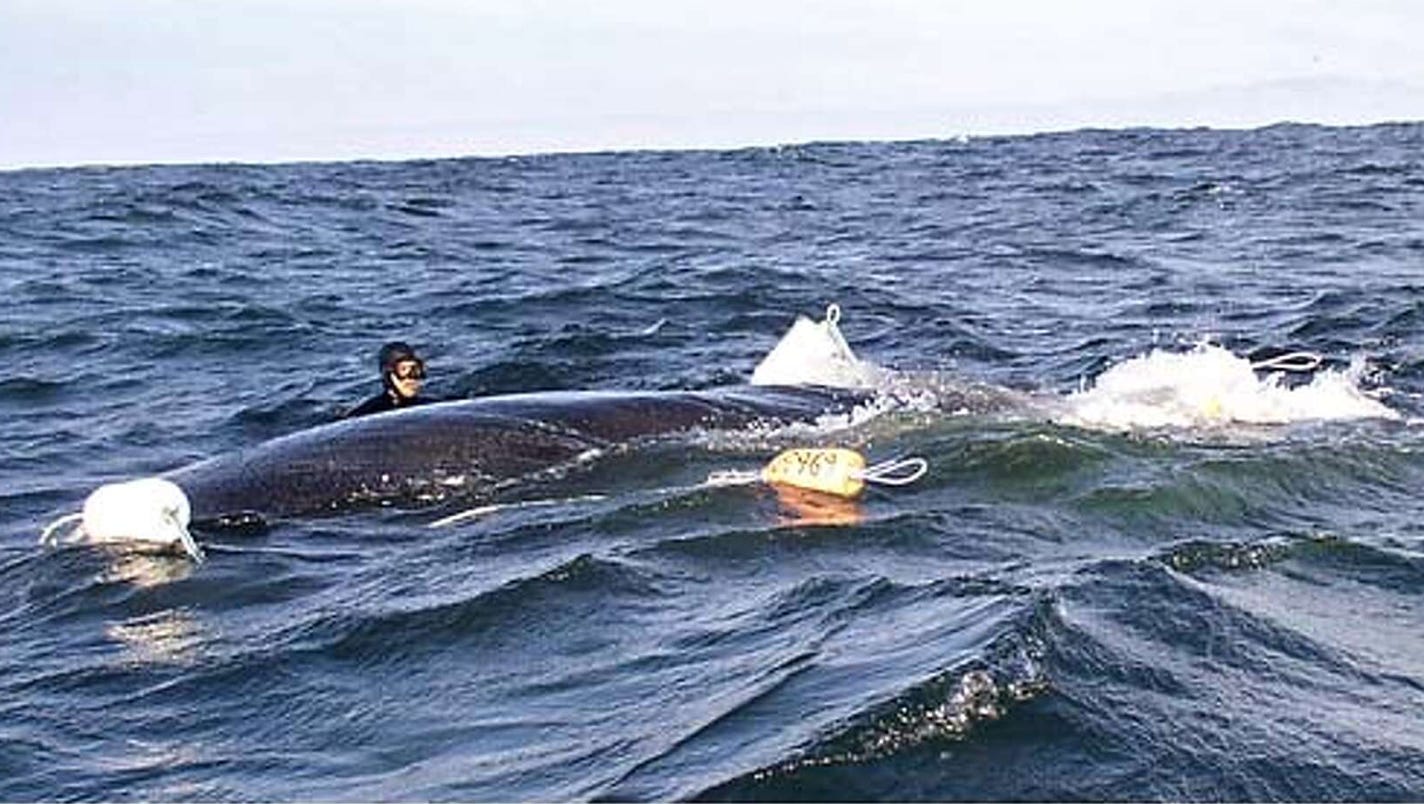
(2)
The people who got in the water with the whale knew how to dive. They were indeed water people. They had the gear, they came in boats. But that isn’t really the point, except to pause and point out that the muscles they’d been building all their lives were what got them in the water despite the odds when this very critical moment, that none of them had anticipated or trained for, arrived.
They didn’t decide that what they did (or its success) mattered, they decided that the whale mattered. And it was this, more important than fear, that made it worth the risk.
But, if I’m going to overdo the metaphor, we can’t leave it to the divers. Someone needed to drive the boats while they were in the water. Some needed to stand at the rail and hold that big picture perspective for the people cutting one crab pot line at a time. Some filmed. Some ran the radio. Someone wrote the article. Someone sent it to me.
And here’s perhaps the biggest thing of all. The man who spotted the whale in the first place was a crab fisherman and the whale was trapped in crab lines. Just the same, he decided to call for help rather than sail on by or look away. He didn’t sail on by because whales, well, they’re just whales. He did not sail by because, well, damn, that’s just how it goes sometimes. He did not sail by when he witnessed how his very way of earning a living had endangered another creature. He did not sail by when he was confronted by the reality of the danger of the crab lines that had been pointed out over and over and over again (and ignored).
He stopped.
He put all that aside, and he called for help.
The most inner part of him moved from his heart to his hand and his voice, and he lifted the radio to his mouth.
I could go on in this fancy way but I want to say that this man stopped and acted because his ballast, his internal north star, the thing that keeps him upright, saw a creature in distress and he felt the deep urge to help. He put out a general call and then folks got in their boats, and crossing 18 miles of big ocean, they came.
They, too, felt their north star.
When they arrived, they did not yell at the crab fisherman, flip him off, call him names, blame him. And he did not fight with them either.
They also didn’t stand at the edge of the boat observing the situation and talk and talk about how terrible it was, read articles about it, rant at how the crab industry needed to change (they did not do the dinner table conversation that makes us feel like we’re doing something when we really aren’t). They didn’t do all these things while not really watching, not in a heart-based way, while the whale sunk past the point of her survival. They took a deep breath and got in the water.
Looking at the impossibility of the situation, knowing the immense risk to themselves, they got in the water anyway. I’m sure they must have discussed what to do, as best as they could, some talk with purpose matters, but then they leaned into their fear, shut up, and got going.
These folks had jobs (that were supposed to be happening right then), and loved ones, and all the things a life worth living comes with. And yet, they each answered the call, they chose a whale over all those things, and there in the frigid rough water, they slowly, carefully, and with love, cut away rope after rope until she was free.
Somehow, beyond the odds, they saved a whale. One whale in a vast and powerful ocean.
Did it matter? Does one whale’s life matter?
I think for me, this is where and how this wondering finally gets answered.
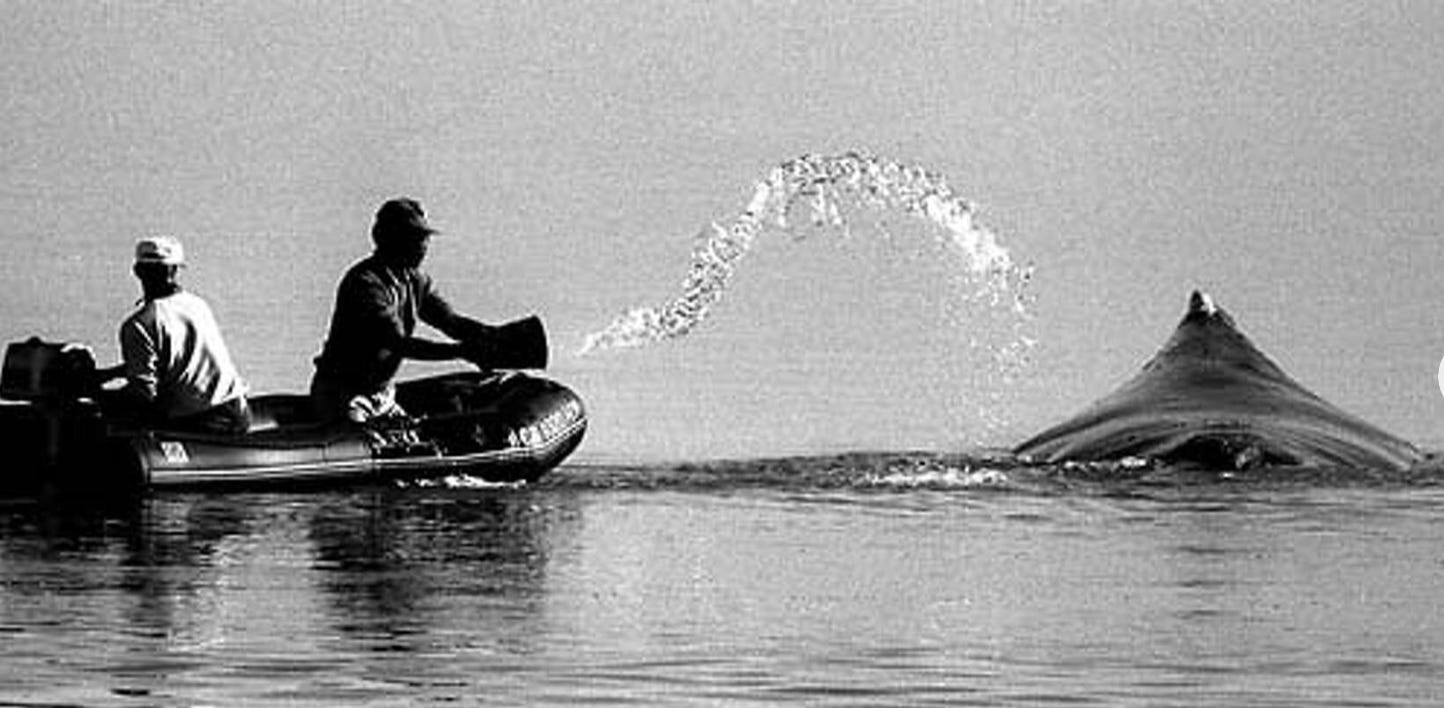
(2)
Those divers? The crab fisherman? The other folks there that day?
When they crawl into bed and pull their covers up? I have to imagine (and from reading their story it seems to be true) that some critical part of them rests easier now. Because they touched the world as though they and that world were one, that each mattered as much as the other, but one had the power to help, and so help they did. What healed? A whale. Some part of the greater balance of the ocean. And, I’d say, them.
We cannot protect ourselves, our families, or our children by ignoring the rest of the world. It’s a myth. It’s a story we tell ourselves to keep ourselves safe and comfortable.
Unfortunately, when we don’t work for us all, we doom, now or down the road, the very people we say we love the most.
I know that here is where I should do the full twisting dismount. But instead, here’s where I tell you the absolute truth. This particular wondering has taken me months to finish. Forget the sheer entering and reentering of revision and adding and subtracting, I have started this wondering from scratch a full three times.
The truth is that, so often, I have no evidence that what I do makes a difference. Maybe I never really do. And to be honest, I don’t usually even know what to do in the face of all this. These times are really hard, aren’t they? And so, I have struggled and struggled with this piece. Because, truth be told, what I do may not matter. I may not make a difference.
But with the hitting of the wondering — is this even the right wondering? — I think I found my answers.
Does what I do matter?:
Who cares? What I’m doing it for is what matters to me most of all.
Is it worth the risk?:
Yes, it is. Because it’s more important than my fear.
And people, we are here, it’s now or never.

Amazing to all present that day on the water, when the whale was free, she swam to each diver, nuzzled them, and then played. After, she swam off, into her life. And they were changed.
That’s what fierce love does. If we let it. So, let’s be brave. Hold fear’s hand, and go forward. Day by day, let’s build the muscles. Show up each morning and answer what it asks of us. Speak truth, don’t buy the plastic (bring a reusable water bottle everywhere and be thirsty when its forgotten), refuse the straw or the excess individual packaging, teach our children (and ourselves) we don’t need everything we want and don’t need it within 24 hours, reduce our flying, wash the few plastic bags we actually need once we buy Tupperware, march in a protest (no sign needed, every body matters), or drive by and honk and give a thumbs up (but join the next time!), call our congress people and governors and city councils, write emails/letters/sign petitions, give money, turn off the constant tv but do read the news, stop making fun of people who eat plant-based diets as they’re almost always doing it for the earth and its creatures, film ICE, volunteer for any of the myriad organizations that so desperately need help now, stop supporting the businesses that are funding the destruction of our country, build real community right where we are. Breathe for one mother’s son, one mother’s daughter, for all of our children. Don’t stop at one thing or one act. This is a long game. It will never be enough, but that’s not the risk.
Never miss seeing or participating in the abundance all around us. To participate, to enjoy abundance, is not slacking on our duties, it’s part of them. We have to refuel, and nature, and its people and its creatures, are so very beautiful. Rest. Exercise. Eat well. And, finally, don’t go it alone. Invite a friend to accompany you. Hold their hand, look up, and do all you can to clearly see the sky. I’ll be doing my best to do the same.
We may never see the results of our individual actions, but here’s where my wondering has come: I do believe what we do matters, simply because of what it does to our core. And when I see you act from your core? I am all the better for it.
Thank you for that.
Where there are hundreds, we need thousands. Just 3.5% of us will change the world (3). Let’s go make it happen. And I’ll see you back at the courthouse, literal or metaphorical, next week.
***
Thank you for reading. If this essay speaks to you, please click the heart, leave a comment, subscribe so you know when I release the next essay, recommend to another person, share, restack. I especially invite you to share this with others via social media or by email.
One or all, each of these actions make a huge difference in this writer’s life and the on-line algorithm. Thank you!!
Sources:
On August 12, 2024, in a discussion on Elon Musk’s X
Amy this is so beautiful. I loved how you wove the story of the whale, your dream and the very real crisis we are in right now to remind us how we can make a difference.
What a powerful essay! I think that you nailed it with your reasoning about what a single individual can do. Keep “wondering”. Your thoughts make a difference. Mike