
Do We Evolve?
Wondering #14


“The work of the writer is not so much to nail anything down, but to make space for the endeavor of curiosity. To widen the theater of wonder.” Ocean Vuong
In the hedge of lilacs outside my front windows, there must be at least one nest of sparrows because occasionally a bird flies in and an enormous burst of chirping ensues, along with a flurry of wiggling branches. The lilacs are blooming, and last night, the scent of flowers was so thick in my living room that I finally shut the windows. Who would have dreamed this possible?
Notice the abundance, the reiki practitioner said to me.
Alongside, Feel the pain, she also said, Notice the abundance. And as paradoxical as it is in this time, when just yesterday I became the woman who claps her hands to banish two cats from the hedge and away from what they’ve surely confirmed are baby-filled nests, the abundance of nature is everywhere. It’s everywhere. It’s so everywhere right now that it’s almost impossible to believe there are humans doing what they’re doing, here in town, all over this country, and all over the globe.
And so the imagery goes. Lilacs and nestlings, marauding cats and on, into the wondering
Do we evolve?
After the election, I went through a period of despair. It was the deepest despair I’ve ever experienced.
I’d lost faith in humanity. More clearly, I’d lost faith in humanity’s ability to evolve. Even more clearly, I’d lost faith that we were living any differently than we had 2-3000 years ago in terms of how we care for one another and all the world’s people. This was a loss I wasn’t sure I could navigate.
What’s the point in living, after all, if we as a species are forever stuck in a cycle of decimating one another in favor of our own interests?
What’s the point of all the great lives that have been lived and given on our behalf if we will actually never change or truly be changed for the better?
What’s the point if we’re going to continually choose ourselves (and I mean our short term, most base selves) over everyone else, even when these choices come at the deepest expense of humanity, our children, the planet we live and depend on; what’s the point?
What’s the point of doing our best to walk lightly and fiercely and lovingly through the world when most of the world around us does jack, wearing contemporary clothing and often contemporary expressions but stuck in the same old same old patterns of selfishness, complacency, and violence?
See?
It was a dark time. I’d never felt so existentially heartbroken. Or lost. Or hopeless. It was a what’s the point situation.
Don’t get me wrong, in individual human years I’ve been alive a fairly long time now, and I’ve seen our awfulness. It’s not new. And I’ve certainly seen my own. Unfortunately, it isn’t new either. I’ve just always believed more strongly in the light. In our light. In its rising. In our ability, despite all the obstacles - internal and external – to evolve.
This is because I’ve also witnessed how, in the midst and aftermath of every horribleness, there are forever people who reach deep to bravely self-inspect, learn, grow, and act – and people includes not only the amazing veterans of fierce love, but newbies as well. Over and over again, this has been true. And to witness this thing that doesn’t often make headlines yet is perhaps the most beautiful part of our species? Well, for me, it’s been the material of hope.
But then came November. And the understanding that half the nation had chosen hate or exclusionary self-interest. And that the whole world was in the midst of this same battle. And that most people with huge power didn’t care a rat’s ass about those who don’t have power (aside from virtue-washing for image). Add to this the bonus view of the population who said they didn’t want this outcome and yet did nothing to stop it. This included so many people I know and love.
It was like the election took this culture of ours - a culture that chases youth and beauty and class and riches and power and fame and feel-better lies at the expense of everyone and everything else - and then put all those folks on one big platter, and served it up to us, saying, Here you are.
Here you are.
And snap, there we were.
Here we are
Valerie Kaur offers a twist on this, You are just a part of me I don’t yet know (1).
Damn. It’s a beautiful saying, isn’t it? I had the gift of hearing her speak in March, so I know it’s Kaur’s acknowledgment we’re all connected. It’s how she allows herself to see that people who hurt others are operating from their wounds. It’s her way of giving space to everyone to have the chance to be seen, loved, and healed. It’s her remembering the shared humanity in each of us, her internal invitation to choose love in the face of so many other understandable ways of being in the world. And it’s her gentle suggestion that we look, we see this, too.
I think what she’s suggesting is central to the fabric of evolving. I know it is.
But all I could think in November was, Here we are. There YOU are. And YOU and YOU and YOU.
Of course, I WAS THERE, too. And there was nothing beautiful about us. We, the majority we, had not chosen love. I did not want to see this part of us. How solid and expanding it seemed to be.
Because if this was us despite centuries of opportunities to grow, I wondered, Were we even capable of evolving? And, if we were capable, would we ever choose this path?
And was this even the right question?
What does it even mean to evolve?
Can’t get started wondering together without a common definition. Full disclosure, I thought evolve would be straight up easy to define, but when I went to old Google to see what the dictionaries said, I realized, Huh. Won’t be as easy as I thought. Here’s why: their definition of evolve and mine are different in a pretty fundamental way.
For example, here’s the Cambridge Dictionary definition:
‘to develop gradually, or to cause something or someone to develop gradually’ (2).
Reading that, I thought, Develop is such a broad word. It could mean anything. Take a cow as an example. If allowed, a calf develops into a cow. So, per this definition, a calf evolves into a cow. This means it grows an adult body and can do different things now that it’s big, like make babies, produce milk for infinity, communally fart up part of the environmental crisis, fill a freezer with steaks. For Cambridge Dictionary, when it comes to a cow, the meaning of the word evolve holds no good or bad, no better or worse, no thumbs up or thumbs down, no super cow or villain cow, no moral arc of the cow universe. The better or worse assigned to said cow comes from outside, in this case from a human’s determination of a cow’s purpose, and not from what that cow wants or hopes for itself. (We don’t ask. Do we.)
Take one more example using Cambridge’s definition. A small company evolves into a multi-trillion dollar company. If we were playing a bar game, people might yell, Good! Thumbs up! Super company!, because they might find this a triumphant thing. The founder or CEO might even obtain hero or heroine (less likely) status among those folks elbowing the bar (or boardroom table). And yet, while this multi-trillion dollar company has developed and now makes more money (at least for its shareholders) and assumably pays its leaders much much larger corporate salaries (I was just reading about the CEO salaries in the military/weapons/energy sector that start in the tens of millions of dollars), evolving in this scenario simply means that the company gets fiscally larger.
The meaning of evolve in this scenario does not in any way hold a values-based judgement. While many may think getting fiscally bigger is good, Cambridge’s definition doesn’t imply that. Neither does it signify that the evolved company now produces things that make the world a better place, nor that it takes better care of its employees, service providers, customers, the physical place in which it manufactures or distributes or disposes of its products, or the environment at large. In fact, the complete opposite may be true, and often is. Take a weapons company that will only evolve if it increases profits every year, which means selling more weapons, whether they’re needed or not, and perhaps creating markets for weapons that didn’t exist before. Think about that. Yet still we’d say, per Cambridge, the company has evolved.
So, the dictionary definition holds nothing but basic growth. And I begin to wonder, Huh. Is this part of our problem?
Once I tell you my definition, you’ll understand my Huh.
I returned to old Google and read more dictionary definitions, admittedly to find support for my own meaning. That’s when I realized that the dictionaries all define evolve by using words similar to develop; words like change or complexify.
Here’s the rub (for me). Per the dictionaries’ definition of evolve, a country can evolve from a democracy to an autocracy. A violent power struggle can evolve into a genocide. A tobacco company can evolve by creating new markets among children in nations that don’t yet have laws against this. (Yes, there’s the word devolve, but the dictionary definition of evolve doesn't signal devolve’s existence, which is interesting, hmm?) So the rub is that none of the standard dictionary definitions of evolve have a morals/values-based context attached to them at all. Well, huh, I thought again.
Their definition has no north star, no moral core or impulse, no implication of values embedded in the meaning.
And my definition does. So, full disclosure, on this page, right here and now, I’m not going to wonder into the dictionary definition. I’m going to wonder into my own. Because, in my mind, that’s the only definition that will save us.
My definition
Before Google (and we could pause to consider Google having no morals but this is not that wondering), I would’ve said of course the definition of the word evolve is tied to a moral compass. But now, I see it isn’t. And so, I acknowledge that my definition of evolve and its tie to an internal north star, that still small voice so-to-speak, is one I’ve read and heard and witnessed and ultimately sewn together from life. My definition ties to humans, and I acknowledge it’s not based on a moral compass; it’s based on mine. Humbling, but clarifying.
For me, our moral compass isn’t who we are. It’s aspirational to who we want to be. So, to me, the word evolve essentially means the growth of our own ability to live actively aspiring to our deepest values and morals, always based in love.
You would not believe how many paragraphs I had to write to even begin to articulate that.
An evolved person is one who’s open to growing, has grown, and continues to grow, in ways that allow them to live toward and according to their deepest values and morals, all based in love. Evolving includes the pursuit of justice that such love requires.
An evolved person sees the world as beautiful in its complexity, individuality, and nuance. They embrace the simplicity that love for everything requires, all the while acknowledging that, for us humans, it’s not so simple. They dedicate their life to living this way and return to it each time they fall off the wagon. An evolved person is a verb much more than they are a noun. They’re perpetually in process.
So, is being evolved tied to our ability to Love?
Yes, I think so. I believe so. And I wonder, does it always come back to this?
Yes, I think so. I believe so.
What is Love?
This one I’ve wondered about for decades at varying levels, and then bell hooks’ book, all about love, evolved my definition of love in a way that feels so true. Her words answered wonderings I’d been grappling with deep in my heart, grapplings about relationships that presented as love but didn’t feel exactly like love, deep inside.
In all about love, hooks writes that to
“truly love we must learn to mix various ingredients—care, affection, recognition, respect, commitment, and trust, as well as honest and open communication.”
Love’s definition, inspired in part by Peck, holds
“‘the will to extend one’s self for the purpose of nurturing one’s own or another’s spiritual growth’ (Peck).”
She explains the word spiritual so it can’t be mistaken for (or manipulated to justify) wrangling someone into your own particular religious belief system.
“Some folks have difficulty with Peck’s definition of love because he uses the word “spiritual.” He is referring to that dimension of our core reality where mind, body, and spirit are one. An individual does not need to be a believer in a religion to embrace the idea that there is an animating principle in the self – a life force (some of us call it a soul) that when nurtured enhances our capacity to be more fully self-actualized and able to engage in communion with the world around us …When we are loving we openly and honestly express care, affection, responsibility, respect, commitment, and trust.” (3)
Love is a thing we do, hooks writes. It’s not a magical state of being that descends via a glittering wand but a series of ongoing choices and actions forever forward. And extending ourselves for the spiritual (mind/body/spirit) growth of the other (or ourselves) does not, ever, put us above others. Imagine it as sitting across a table, seeing, listening, talking as equals. In this love, even if one is better at the verb itself, I am not better than you. You are not better than me. That is love.

This election affected my evolution
Here’s what happened. I lost love for a while.
Perhaps the closest I’ve come to Kaur’s words is that I believe I can see another’s self in their eyes. It makes going out into my day a wonderful thing. I look in your eyes, think, There you are, and usually you look back at me in return, and maybe you see me, too.
It’s an experience that’s true, a window of the soul sort of thing. It connects me to you. It changes me.
Sometimes a person isn’t in their eyes, or is there but flicking in and out, or is hardened, grasping, or afraid. That’s not a lovely connection, but it’s important – it gives me the chance to understand they’re wounded. Seeing it humanizes them, and me.
After the election, though, I realized I’d stopped looking people in the eye. I don’t know if I’d stopped believing in our light, or no longer believed in its power within us and through us. I know I was suspicious and angry and hurt and betrayed. One of the most central elements of me, a heart-power source, I’d closed down.
Truth be told? I couldn’t bear to look. I couldn’t look at you. Or you. Or you. It was as though the light had gone out everywhere, but most of all in me.
I’d lost hope. And I couldn’t bear to feel that. I was unwilling to feel it.
Tara Brach said that to heal “we need to contact directly, intimately, perhaps what we have been unwilling to feel. … Because we humans organize around not feeling what’s difficult, and unless we care more about truth than we do feeling comfortable, we will side-step it.” (4)
So, I called my therapist. It was an SOS. First, I cried out to her, How do I navigate this? (In Wondering #9, I wrote about her response.) Essentially she said, Be here now.
My second cry: Do we evolve?
I didn’t write about her second piece of wisdom then. Though I’d begun to touch it, I wasn’t ready to enter the page regarding my greatest fear of all, the thing that’d led me to the bottom of the barrel, the idea that we don’t actually evolve. It was terrifying, this idea that perhaps we were in the same low and awful place humans have always been. That nothing we did mattered because we’ve always killed one another, we’ve always killed the prophets that call us to love, we’ve always taken advantage of the marginalized, ad infinitum, and we still do. It was an awful fear. It still is.
To that cry, my therapist asked me a question:
Amy, are you thinking of evolving like this? And she held out her arm, horizontally, kinda like this:

And then, keeping it flat, she raised it as though it was an elevator, rising upward. What she was illustrating was, Do you think of our evolving as all of us on one single raft, rising together, higher and higher at the same time, evolving side by side in our ability to love?
This stopped me. I thought, Oh.
Oh, I said.
Because, no. I don’t think that. At all. I just hadn’t realized I was grappling with my despondent wondering as if I did.
Then, in contrast to that arm elevator, what popped into my head like a vision was a print from my friend and fella gardener Ray that I have on the wall, and here’s the key part:
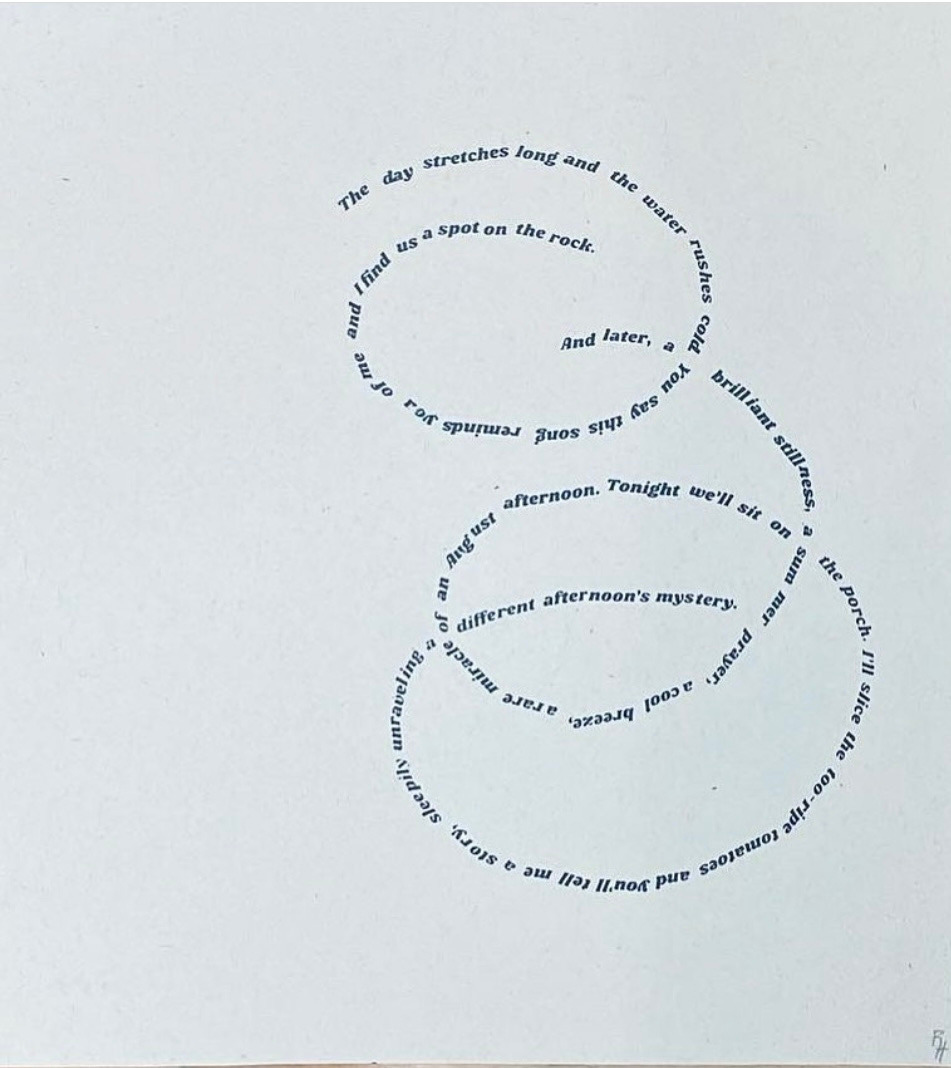
See, in that vision, I saw my true image for evolving, and it was a spiral, going upwards, even a little bit loopty doo like this one (5).
And then Ray herself popped into my imagining. Ping! There she was, high up on that spiral, her little human spirit traveling along, and I understood that my friend, doing her best to live a life of truth and love, is evolving, living in a way that’s working her path upward. What I realized then, in answer to my therapist’s question, was, Oh! Humans evolve on a spiral like this, and everyone is at a different place.
I know, I know. It's not revolutionary.
And then I thought of friends, or my kids, or dad, or or or, so many people even beyond my heroes, and I said, Oh. Oh. And as my therapist watched me, she nodded wisely, though really I have no idea if this memory is true. Doesn’t matter, it fits; she’s on the spiral, too; somewhere where I’m sure she can see the light.
I understood. We're all somewhere on that spiral, whether paused, sliding down, or loving our way along, higher and higher toward the kind of constant love I described earlier in my definition of being evolved. We are all over the place, but we are there.
Do we know where we are on the spiral?
In the end, I suspect this is a thing we shouldn’t wonder about. It goes so easily to ego, doesn’t it? Perhaps asking, How am I doing at bell hook’s loving is a better question? And then requiring real evidence?
Because as far as personally understanding where we ourselves are on the spiral of evolving? Probably we don’t. I wonder if it’s something we’re even capable of seeing, here in our human suits.
Side note: One truth I have observed is that overblown egos are usually wrong about themselves. Last night, for example, on a stop in his book tour, Chuck Schumer likened himself to Moses. (Goodness, I want to giggle.) He sat back in his chair with one well-clad leg casually crossed over the other, and talked with what I can only describe as a sense of profound smugness, self-appreciation. Moses, he said. Oh good Lord, there are so many layers in that moment, aren’t there?
The top two:
a) one of our most powerful political leaders is on book tour as people are being snatched off the street by masked federal agents, children and their families are being starved at a genocidal scale, people non-violently protesting are being beaten by police, and basic human rights and services are being evaporated right here, right now
b) he is yet another contemporary leader likening himself to godlike or prophet-like status. My giggle dies on my lips.
Interestingly, what I’ve observed is that the more someone thinks they’re evolved, especially when they’re willing to say it aloud, usually the less they are. This does not just happen at the leader level. So, my conclusion? Let it go. Head back into love.
Real love keeps us humble.
Ok, do we individuals evolve?
Considering Ray’s spiral, Yes. I think we do.
At least I think, We all have the potential.
We’re each in process. Stuck, sliding, climbing, flying. But we can. We can.
So, why am I still writing?
When I reached this We can, I thought, is that it? And uffdah, I knew it wasn’t because a) real wonderings don’t wrap up with a neat bow, and b) I could tell there had to be more because the bow wouldn’t tie. There was no exhale of a final-ish ah ha.
One of the places I was stuck was this: if I believe that as individuals we evolve (or can) (and I do believe this), why the long face? Why the long heart?
I mean, if there are always people moving higher and higher on the spiral, shouldn’t things be better than they are? I mean MUCH EFFING BETTER? If people evolve, shouldn't the world around us look different? Shouldn’t we see the effects of bell hook’s love? Shouldn’t we be swimming in it right now?
Individual, Societal, Species?
I told my son what I was working on, and he said: Mom, do you mean evolve individually, as a society, or as a species?
When shared, wondering doesn’t stop. It’s cool that way. And annoying, too, when you’re writing about it.
Hmm, I said to him, hmm.
I carried his question in the back of my head for a long time. And then, between the reading and learning I’ve been doing along the way, my general wondering about history, and all this unfolding on the page, his question rose again in a new light.
Society: definition
Cambridge: “a large group of people who live together in an organized way, making decisions about how to do things and sharing the work that needs to be done. All the people in a country, or in several similar countries, can be referred to as a society.”

Fancy cars, electric tooth brushes, and white shiny rockets
It’s often argued that society has absolutely evolved because we have better medicine and housing and potato chips and flushing toilets (flushing toilets in any form are indeed a powerful argument), and computers that will do human work for us and in place of us, plus shiny white rockets being developed to save three of the entire earth’s population by putting them on Mars.
And yes, these and so many more developments could signal that our society is evolving if we used the Cambridge dictionary definition of evolve. The one with no moral compass, no ballast, no heart to guide a society to its soul/values-based true north. Remember, the only measuring stick in this definition is growth, the progress that’s visible in terms of industry and success.
So, let’s return to what an evolved society actually is. Because I do not think it’s that.
What is an evolved society?
At this point you know where I’m headed because it’s no different in foundation than my definition of an evolved human. My definition of an evolved, or evolving, society would be equally based not only in bell hook’s love but the words of so many (all?) of our world’s spiritual, justice, and heart leaders. Here are just a very few:
“love is an active force that leads us into communion with the world. The choice to love is essentially a choice to connect, and we can see that it was love all along that has been sustaining our lives. Once you learn that you can see yourself in the other, you will not turn on the others as if they never mattered, as if you never mattered.
If we could create an environment where everyone understands that we make a choice to love, then we will also be able to learn how to take responsibility for our choices and be accountable for our actions. In order to do love, we must choose not to do harm, as they cannot exist together … The gift of love is that it offers the experience of knowing we always belong.’ – bell hooks’” (6)
“Power without love is reckless and abusive, and love without power is sentimental and anemic. Power at its best is love implementing the demands of justice, and justice at its best is power correcting everything that stands against love,” MLK (7).
“Do I free only myself? Or do I turn back for those left behind?’ (8)Valerie Kaur
And, unless you are buying into the argument from current false Christian prophets (aka current U.S. leaders) that Jesus actually did not want us to feel empathy, or practice what empathy asks of our true north, well, you can look to the most central tenants of any of the world’s major religions and there will be Love.
Yep, the bell hook’s sort of love. You know, the love your neighbor as yourself sort of love. Just look at this anti-empathy:
4 Love is patient; love is kind; love is not envious or boastful or arrogant 5 or rude. It does not insist on its own way; it is not irritable; it keeps no record of wrongs; 6 it does not rejoice in wrongdoing but rejoices in the truth. 7 It bears all things, believes all things, hopes all things, endures all things. (9)
Or the Sermon on the Mount love,
“Blessed are the poor in spirit,
for theirs is the kingdom of heaven.
Blessed are those who mourn,
for they will be comforted.
Blessed are the meek,
for they will inherit the earth.
Blessed are those who hunger and thirst for righteousness,
for they will be filled.
Blessed are the merciful,
for they will be shown mercy.
Blessed are the pure in heart,
for they will see God.
Blessed are the peacemakers,
for they will be called children of God.
Blessed are those who are persecuted because of righteousness,
for theirs is the kingdom of heaven.
What about our society and love?
Right before our eyes, and once again, we’re throwing all those words away. Just compare our leaders to any of those guiding messages. It’s clear. Our society is giving love the angry thumbs down.
Perhaps this is the source of my long heart. We’re ruled by people who increasingly encourage us to hate and kill and wound and silence and punish and starve and look away. To keep only ourself safe, which really means keep those leaders safe. And we aren’t the only country. These leaders are in league with one another, actively creating societies of de-evolvement.
Kaur says there are no monsters, there are only wounded people. I know she’s right and yet I struggle with this; it’s so hard to watch the incredible cruelty of what’s happening. Their very demolition of possibility for anyone but the very rich. The demolition of the earth so it won’t matter in the end anyway. Watching makes me wonder, at a societal level, what happens when wounded leaders, acting in monstrous ways, ask their wounded followers to do the same? When they preach anger? Hate? Violence? That empathy is bad? When they deliberately wound more and more people? What happens to society in an avalanche of wounded hate like this?
Just last week, I held a sign to Feed Gaza, Gaza being one place (like Sudan) where most of the nation is on the brink of starvation. Already more than 50,000 children have been killed or wounded (10), and “nearly 71,000 children under the age of five are expected to be ‘acutely malnourished’ by the end of the month” (11).
Feed them, was the message on my sign.
I’ve been told, It’s complicated, but is the meaning of these numbers complicated? Really? At the bell hooks love level? What does complicated really mean when it comes to a starving nation if we examine it under the light of bell hook’s love? Could you look a mother, holding her starving child, straight in the eye and say, It’s complicated?
I held this sign because we - our society that’s paying for and supplying the weapons being used against Gaza, a use of weapons that the U.N. has called a genocide (and this word is only used by the U.N. with the utmost seriousness) - also have the ability to feed these trapped people. These suffering and dying people. Our society has the ability to save them. Instead of increasing military spending by 150 billion dollars, we could use some of that to save starving people. Couldn’t we?
As I stood there with my sign, on a local traffic circle at 8am, a woman in an expensive car drove by. Now a few people in varying cars had already driven past and shaken their heads. We disagreed, but this woman was different. Escalated. Angry. And she had two children with her. As they approached, all of them looked at me, and with furious energy, did the thumbs down motion over and over. Not much later, when she drove by again, she and her remaining child repeated the gesture.
Then they pulled their $100,000+ car into the adjacent Catholic school’s parking lot for school drop off.
Individual or society?
Here’s where the wondering begins to get intertwined. If I consider my son’s question, was this thumb moment an example of the evolution (or devolution) of an individual or society? I mean, a mother who teaches her children to angrily thumbs down feeding starving people is an individual. True. But as a mother, isn’t she also the creator, or co-creator of a mini-society — her family? When we, as parents, teach our child to hate or love, nurture or deprive, are we individual or society for our child?
I wonder, is a family the first tier of society? I mean, think of the power of a family’s teaching, passed generation to generation. It’s teaching that, without active and conscious individuation on the part of the individual, influences our very way of being in and seeing the world. It can even be teaching invisibly rooted 200 years in the past.
I doubt this woman thought she was creating a society based in not caring for others, but that’s what was happening, yes?
My wondering around society and this woman then went from what she was creating to what created her harmful, (let’s name it: hate-filled), thumbs.
What influenced her deep anger? I mean, she was headed into a Catholic school that she’d clearly chosen for her children. Yet the Pope just called to stop this conflict in Gaza and for us to feed the people. The last Pope did, too. So, she’d clearly decided to ignore him. Perhaps she made this anger up on her own, an anger strong enough to stand against her child’s church society? But this didn’t seem so possible. So I wondered if she got this angry thumbs down from a different source. And where?
What about systems?
This is where the interweaving of the do we evolve wondering gets even more tangled; be warned. Her thumbs: individual, societal, systems? I couldn’t walk enough. Deep in the work, I talked with my daughter, and she added more thinking. Aka, depth. Aka, yay, and sigh.
Here’s what she asked: How do systems play into our evolving?
I didn’t only say, Hmm, to her, I sat back in my chair and said, Would you please write this for me?
I so often wonder, why doesn’t the world push past its discomfort to listen to our children?
Systems definition, mine
A system is a way of doing things, a philosophy made into process. This process guides how we live (and think), whether we realize it or not. Could be religious, economic, legal, information, criminal justice, food, political, even foundationally social – race, gender, class, etc. Systems and societies are so intertwined, by the way, it can be hard to separate them, but systems underpin societies and societies keep systems alive. Maybe the systems are the veins carrying juice all over the body, and societal bodies give the systems a home?

Our information providers are a system
So this woman, this mom. What fed her? The news? The question paused me, I hadn’t thought of our news sources as a system before. But news and information providers are a large vein in the body of our society, yes? And the news system has dramatically evolved and de-evolved over the last short number of years.
There have always been the rags – the newspapers next to the cashier that report aliens impregnating cows, etc. Wild and implausible (again no one asking the cow), but lies almost everyone recognized, lies that made waiting in line amusing. Unfortunately today our news sources are so profit-driven that viewership and monetary support have become more important than anything else, and some of our major new sources willingly provide false information.
Fox News and Entertainment, for example, had to add and Entertainment because it lied to viewers at such a scale that it kept losing vast sums of money in lawsuits. ‘And Entertainment’ was a phrase that let them off the hook. Entertainment doesn’t have to be true, you see.
And yes, some new news systems have evolved. Instagram posts, for example, let us witness the real time violence of NYC police toward peaceful protestors, especially in ICE or Palestine protests, or of ICE agents all over the nation, or L.A.in general! Thank goodness because most mainstream news is choosing not to cover five policemen kneeling on one peaceful protester’s back and his later hospitalization, or another kneeling on a protester's neck until he’s peeled off, or officers pulling women by the hair, or masked men pulling people off the streets without warning and throwing them to the ground, peeling babies from women’s hands, entering elementary schools, cuffing children, breaking car windows, running over a protester and then driving away, all without warrants or real identification. Take a breath, Amy. Mainstream news doesn’t want to risk losing the money. Our government and it’s corporate sponsors, after all, will fiscally punish them, if not worse.
And so, we have to go to the individually shared on the ground news because the systems we’ve counted on are not providing the facts of what’s happening to our population.
It’s changing a little. This past week, finally, on mainstream news, we were shown a Senator thrown to the ground and cuffed for asking a question at a news conference, and then a NY mayoral candidate (and elected official) roughly being arrested by ICE for doing his job, but the conservative news networks told their viewers false stories to blame these men and omitted the part of the video that showed otherwise. They also omitted the fact that these men were simply doing their work.
A current societal norm is that winning matters more than truth. On the brink of cutting Medicaid via the budget bill (cuts that the Congressional Budget Office says will cause more than 10.3 million Americans to lose health care coverage), Aaron Rupar reported that Fox and Friends (6/2/25) mentioned Medicaid only once. It mentioned Biden 39 times. (12)
Think about the power of this system on the individual. Fox and Friends’ viewers will be tragically affected by these Medicaid cuts but don’t know what’s happening because their major news system won’t report it. Evidently, half the nation also doesn’t know what’s in the ‘Big Beautiful Bill,’ a bill that’s going to decimate all aspects of this nation except the bank accounts of the very rich. Does this make an individual’s support of the bill individual, societal, or systemic? When it comes to evolving - let’s be clear, devolving - which is it?
So, guessing from her actions that the thumbs down woman watches conservative news, it begs the question, what does she know of Gaza that’s true? How are her systems informing her behavior?
See, Fox News and Entertainment also doesn’t report the starvation in Gaza, nor the killing of its citizens with weapons we supply, nor the amount of money we’re spending on these weapons. In addition, Fox reports that all Palestinians are terrorists and anti-semitic, alongside Americans who speak on their behalf. And their viewers believe this.
System? But society doesn’t call it out. Society? Nor do the individuals who know. Or could. The line gets blurry, doesn’t it?
Of course, we need to check our facts to make sure they’re real. Yet today there are many folks who simply refuse to consider facts that disprove their beliefs. In which category does this refusal to see things we don’t like fit?
Not in love, I know that. And perhaps that’s all that matters.
Regardless, neither our established society or systems are evolving
My son’s question helped me realize this is the place where perhaps I have the most despair. Because what happens when our leaders strip a society of the systems created to help heal wounds of the heart and psyche?
A hundred years after Hitler, sixty years after McCarthy, fifty years after the Cultural Revolution, a few less after Pol Pot, the Cambodian genocide, and the close of our own Jim Crow era, thirty after apartheid and the Guatemalan Mayan genocide, and I could go on, yes?, in the grand scheme of things, not really all that long after all these awful times a country’s people have been literally decimated by those in power – here we are again, poised on the doorstep with way more than half the country flinging the door wide open, or doing nothing to close it.
History’s lessons cast aside. In its place, easy wishes, anger, fear, comfort-seeking all replace the more complicated choice between what awaits us and love.
Walking through this doorway (or closing our eyes to it) is the choice to follow a leader and his party into the undoing of societal bell hooks’ love. This is not evolving, is it?
All I have to see is one parent forcefully separated from their child by masked men with no legal backing, no repercussions, and the president’s support, and the answer is clear: No.
I wonder, after all the centuries, all the millenia, how can it be that as a society we have not evolved and are not evolving? Is it possible that we’re simply unable to help ourselves? That we cannot evolve? That one man, or group piloting a system, can undo a society and all its individuals and we will follow like sheep?
CAN society evolve?
As I’ve worked, read, conversed, walked, I’ve found myself struggling with the wondering: can society evolve at all?, because, throughout history, peaceful societies have continually been taken over or demolished by those who didn’t want such societies to exist.
I’ve been reading Valerie Kaur’s, Sage Warrior, and her history of the early Sikh society is an example. Based in peace, the Sikh way gave caste no purchase, religion no hierarchy, had everyone eat (everyone fed!) side by side, all as equals. It flourished. Peaceful. Eventually two things came together with intent to destroy them. First, an emperor felt the Sikh’s practices threatened his own power. Second, sons who’d not been chosen as Guru plotted overthrow so they could become leaders. This intertwining of power and wounded ego forced the Sikh people to flee their vibrant, flourishing community for the hills. They survived, but wouldn’t have if those folks who wanted power had gotten their way. And their experience was not one and done.
The Sikhs aren’t the only society based in hook’s love that experienced this. Think of the successful Black towns before and during the Jim Crow era that were destroyed by White communities who couldn’t handle the perceived risk to their own race-based power structure. China’s destruction of Tibet and its monks, and now its destruction of Islam. Destruction of indigenous people living peacefully with the rain forests, killed and cleared so Cambridge growth can happen. Our current U.S., where any program that lifts and supports marginalized or down-on-their-luck people is experiencing drastic cuts in funding (if not a complete shuttering) because spending on the health of people and children in need is considered a waste.
Reading history with this lens, I began to wonder, Is it society that doesn’t evolve, or does a society go down the spiral because an actively unevolved powerful person/group takes the helm and others follow?
Will a wounded powerful person/group always destroy a society that’s based in love?
The emperor who spearheaded the attempted destruction of the Sikh way of life did so because it threatened the societal, caste-based power system that ensured his power. He was one individual but was he singularly responsible? Or did the caste system cause him to believe he shouldn’t stand any challenge to his power and so provoked him to destroy another culture it perceived as a threat? Did the society support the system or the system support the society? And where did he and personal accountability come in?
Can a peaceful society survive a person or system that’s immersed in the need for power? It’s an awful wondering, isn’t it?
Some will perceive this next wondering as blasphemy
In the U.S. (no new news), capitalism is one of our systems. In this system, to succeed as a person, a business, a nation, it’s required we continually grow financially. Our individual success is reflected by our ability to acquire more and more, fancier and better if possible. The illustration of individual success is a lot of (and continually growing) money, possessions, comfort, and power. The measuring tape for U.S. success (society) is a GDP that continues to grow, regardless of how.
But think about that. Is it truly possible for a country (and every single company) to financially grow, year after year, forever? Mustn’t a field lie fallow? A company take time to invest in and grow new ideas? Don’t people who retire need to live on a fixed income, and others to save, and others to work less to stay healthy and raise healthy families?
And yet, under a pure capitalist system, we must ensure none of this ever takes place. Because success under pure capitalism is only possible if everyone spends more every year. Three TVs, bigger TVs. Vacations, cars, lacy bras, and houses. It doesn’t matter if our salaries don’t increase, it doesn’t matter what we spend our money on, or if we even have that money, it only matters that we spend it. It also doesn’t matter how U.S. companies grow or at what cost. It only matters they grow.
So the system must get people to spend their money on things and pleasures. (The GDP doesn’t grow if we make contributions to food banks, for example, even if feeding people who are down on their luck improves a society, and gives workers a chance of working, and children a chance of learning, in more substantial, long-term ways.) Capitalism makes us believe we need things. We’re advertised to in ways that make us feel we aren’t as happy as we could be. We aren’t as attractive, visibly successful, comfortable, or whatever. It gets so in our heads that we spend money to fix, or avoid feeling, this missing happiness. We even do this when we understand the cost to human workers and the environment.
Happiness, kindness, generosity aren’t measuring sticks for success in a capitalist system. Neither is Love.
Am I arguing against capitalism? I wonder about this, and probably I’m not completely. It’s so deeply ingrained, in our nation and me, plus I’ve learned there’s usually not just one straightforward solution to a problem but instead a nuanced blend of many things is what finds its way to love.
But what happens to a society that’s continually told they’re not enough? That only spending money will fix it? And so we become a society where surface wins and substance struggles for recognition? Or that our companies must annually increase profits to be successful, so they choose not to compensate their workers with a living wage, or living hours, or to pillage the earth rather than treat it well? Capitalism makes the number important, not the country’s health.
Our U.S. systems currently in power need capitalism to exist. So do the current people at the top. But why, I wonder, are we regular people so dedicated to it as our driving system?
Examining capitalism’s impact on bell hook’s love, our dedication to it doesn’t contribute to our evolving when we a) use it as our only metric, b) worship it, c) defend it with blind loyalty. Yet, from what I witness, the majority of Americans never really consider alternative ways of living for themselves or their children. Instead, it's become American to support capitalism, and if we offer any other ideas, or nuances, we’re labeled traitors. Or worse. So, we live toward the dream, sold the system so thoroughly we consider it patriotism.
Do we even have free will?, my daughter later asked.
Do we have free will?
Do we feel entitled to something because because our systems tell us we deserve it? Are we supporters of some people because we were taught they deserve it? And the opposite for the same reason? Do we believe, even deep inside, that some people are better or more able because of who they were born? Do we know why we choose the heroes we do? Or why we think it’s ok to compromise our deepest values in the interest of success? Do we even know simple things, like why we think a particular car will make us better than others, a new pair of shoes will make us happier, or that we aren’t pretty or thin or pale or tan enough, or or or?
Money and power aside, ask this. What character elements are there to hero-worship in the people leading our country and industry today? Is there an ounce of humanity in them that extends beyond their own seat in the car? Is there love?
And yet, they are worshipped by many. Is that done with free will?
Are we even aware of the reasons we believe what we believe? Why we support the systems we support? Do we know why we feel we must have what we feel we must have? Must give our children what we feel we must give them?
How conscious of ourselves are we really? Do we have control over how we evolve?

Is addiction part of the systems that ask us to devolve?
If we become addicted to something, we are enslaved to it. We lose our core selves to whatever we’re enslaved to. In addiction, is there free will? Until we break our tie to it, I don’t think so.
I walked in a large and very fancy mall last December, filled with thousands of shoppers. Coming from Vermont, where we actually don’t have malls most of the country would recognize as malls, this California mall was almost a siren’s call. Walking under glittering lights, past window after window filled with things that would make me cooler, better dressed, more fun, and none of that is hard to do, it was intoxicating. Buy me, buy me, that world said. I could feel it. I wanted.
But it was also unhealthy. The light was intensely artificial. The music constant. Robots at food stands took orders with virtually no human interaction, not a smile, question, hello. People didn’t look at one another when they passed. Each person or group was an individual unit, moving like bubbles around one another. And most of what was sold in the mall no one truly needed. Yet, despite California weather, this is where everyone had come. To fill their time, consequences to the burning world be damned. To feed a hunger that, like an alcoholic with vodka, would never be nourished or filled by buying. It was perhaps the ultimate capitalist success story.
Just like endless scrolling, us folks are serving a system we’ve become addicted to. And the addictive things in our society today are not just alcohol, tobacco, gambling, and drugs. Think consumption and accumulation (capitalism), scrolling (tech internet), the ever-playing-in-your-livingroom news (information). Even the loyalty to our current leader appears an addiction for some, one filled with the classics: denial, rationalizing, binges, bad (even illegal) and immoral behavior.
Are we doomed?
Does the U.S. have systems that make it impossible for our country to evolve beyond the dictionary definition? I don’t know.
Has it ever, in its history, moved toward a heart-based definition or has it done the dirty stuff of supporting capitalism off-screen until now that it’s in our faces? (Go read about the Mayan genocide in Guatemala as an example. Read about Banana Republics. These are just the start. Consider our European beginnings of enslaving and genocide in the interest of growth. Each time, ask, Did we value love of people or profit? And who was we? And why are our leaders wanting to erase this history?). Have we ever moved closer to hooks’ love? I really don’t know. Individuals have, I’ve witnessed that, but has our society or our systems?
In terms of evolving, is U.S. society doomed because it serves a capitalist system and therefore must destroy the earth and its people in order to succeed, to Cambridge evolve?
Oh, that’s a hard one.
Devolved systems, societies, and leaders use fear, violence, and addiction to silence love. And sometimes they scale it way way up. We’re seeing this on a massive societal level right now. The systems put in to protect us aren’t protecting us (government, law enforcement, military). Some are being defunded as fast as they can be, others funded. The BBB has provision to hire 10,000 new ICE personnel, 5,000 new customs officers, and 3,000 new Border Patrol agents to detain and deport at least one million illegal immigrants annually. It has $45 billion in funding to build new detention centers that can hold 100,000 people at once (13). ICE is currently paying detainees, forced to work, a dollar a week (14). It’s a new form of enslaved labor, a capitalist dream. They then charge this much for a detainee to make one weekly phone call home. It’s Jim Crow.
It’s not all intended for immigrants either, I’m willing to lay down a capitalist bet on that. Imagine this much new law enforcement, consider how current ICE agents are already operating in a lawless violent masked fashion, and doesn’t their proposed ability to imprison Americans at a mass scale harken to times in the not too distant past in Europe? What about the new law in North Carolina where it’s illegal for for than three people to gather together (as in protest)? Where are we headed? Do you need to wonder?
All the while, our current elected leaders and information systems are running scared. They’re largely abandoning the individual inhabitants of our nation.

So, what about our species?
Honestly, I wanted to avoid this one. But ok. Our species is the sum total of our worldwide societies, systems, and people. Species evolution is the sum total of the actions of those things. Societies, systems, and people that want power and view power as the thing that defines them, destroy. They seem to want to destroy any ability to evolve. They certainly are destroying the earth we need to live. It’s coming fast.
Can we ever overcome the need for this surface-level power? This is another question that makes this wondering so hard. If, always and forever, the people, societies, and systems seeking power will exist — for us as a species, is there hope? At best, I say, I don’t know. I’m pretty sure that’s not what you were hoping for.
Are there alternatives?
It shouldn’t have taken until now to say I also see so many brave, love-based people rising up to act in the face of this. People who want something different. People who are willing to risk so much, sometimes all, for that very thing. Love.
So many individuals standing in the face of the metaphorical tank, alone and together. I see it happening all around the nation. And the numbers are growing. 3.5% of the population came out on No Kings day, some for the first time. It’s a beginning.
And, even as our nation falls apart, there are also communities coming together and furthering and developing alternate systems to serve all people. Many of these alternate systems already existed in marginalized communities. Now, they’re growing. People who have been asleep are joining them. People who’ve been afraid are joining them. They, too, exist with the societal purpose of bell hooks’ love.
Can they survive this current regime? Can they survive if this regime falls and the comfortable option again returns?
I don’t know. But I want to say, I see it. I feel it. Despite all the challenges of human ego and comfort and fear, these individuals, systems, and societies are dedicated to living bell hooks love. They are there, and they’re waiting for us, glad to welcome us in. They’re based in love, after all.
Maybe they’re a part of me I don’t yet know. Goodness, I hope so.
Rebecca Solnit says that the light rises from the edges (15). These individuals, systems, and societies are that very light. They’re the light workers. They’re showing us all how to rise up the spiral, even in the face of such frightening evil.

And so?
This wondering, it seems, brings us full circle to How do I evolve toward love in the face of this?
How our society evolves depends in part on what I worship, yes? What I worship is a part of me I may not yet know. Yet once I choose to see, I have the opportunity to ask, is what I worship Cambridge or love-based?
If I worship growth, I choose growth above all things. If I worship comfort, I choose comfort above all things. If I worship success or power or riches, well, you get the picture. Societies are the size of the U.S. and as small as our nuclear family. And I’m an integral part of them. I contribute to what they are. And so do you with your own I.
And I + your I = We.
So, perhaps step one is to see. Really see. See the world in which I’m living. See the world I’m choosing, not through my words but through my actions. See what I’m choosing as my verb of living.
Maybe the only real answer to this wondering is what the answer almost always is:
Forever and always, it must start within. With I. The buck stops with me. And starts. Because as the spiral is ongoing, so too is my rise toward its top, understanding I’ll never reach it. To focus on outcome, Solnit says, is defeating. To focus on moving toward it is hope. Hope the verb, hope the love.
So, in the end, in terms of individually evolving or not, I think what matters isn’t the outcome but the act of living toward who we most want to be, one by one, I by I by I.
And, in terms of society? What matters is not the outcome but the act of living and creating the society I most want to build, choosing to invest and live that way, I by I by I.
And, in the end, in terms of our systems, what matters is not the outcome but what systems most support bell hooks’ love, and if I continue to develop, support, and use them, and speak and act when the opposite is true. I by I by I.
See, here’s what I think I’m learning through my dark night of the soul. I have no idea of my progress, but I think that before this I was again sitting rather still on that spiral if not taking a downward slide. Instead, in the midst of this horror, I’m having the chance to really see, again, and to do my best to choose.
And I understand something I’ve never understood before: even in this opportunity to grow, if the outcome matters more than my heart-desire, I’ll quit my efforts, and the spiral will again become my hammock, or worse, my slide. But if the process of love matters most, and if the love-abundance that happens in this process is what I choose to feed me, then the spiral will be something I can aspire to through the living of my life.
So I suppose the real question in this wondering is perhaps based most simply in the definitions:
Am I Cambridge?
Or
Am I living, as best I can, bell hooks’ love?
Outcome be damned, I suspect it’s a question we’ll, I by I by I, have to return to again and again and again. And each time we do, we’ll choose to reground in our forward-motion desire to live a life of love. Because what better gift can we give ourselves, each other, the earth?
God speed to you, to me, to us. I by I by I, let’s go.
***
This essay reaches more people if you click the heart, leave a comment, share it, restack it. It’s a simple capitalist algorithm. : ) If my writing speaks to you, please consider subscribing (free is so fine), so you get notice each time I release something new. Thank you for participating in this wondering with me. I appreciate you.
Sources
Valerie Kaur, Sage Warrior
https://dictionary.cambridge.org/us/dictionary/english/evolve#google_vignette
bell hooks, all about love, (pp 10, 13, 14)
This came from a Tara Brach talk and for the life of me I cannot find which one!
Artist, Rachel Hellman
Where Do We Go From Here, MLK
Valerie Kaur, Sage Warrior
New Testament, 1 Corinthians 13
The White House and BBB
On Substack, argh, a immigration rights lawyer. I know, this isn’t a verifiable source. But here's wage back up
Solnit, Hope in the Dark
This just helped to snap me out of something similar to your beginning. Thanks for the light, Amy. ❤️
Thanks for the re-reminder that process always supersedes outcome and that we only have control over ourselves. And in that we may (or may not) influence society/others.